
 Japanese
 English
 Chinese
 Vietnamese
I want to stream a funeral in Ageo City online to family members overseas | Venue permission, communication, and time difference confirmation.
When holding a funeral in Ageo City, you may want family members and relatives living overseas to be able to share in the farewell. If it is difficult to make travel arrangements immediately, online streaming is one way for those in distant locations to connect with the space for prayer and farewell.
On the other hand, live streaming a funeral requires different considerations than live streaming a typical event. There are several things to decide, such as the scope of filming permitted at the venue, how to handle the appearance and voices of attendees, the stability of the communication, time differences with overseas locations, and confirmation with religious figures and officiants. It is important not to rush into making decisions on your own as a family, but to organize your wishes and consult with the funeral home and venue in advance.
The first thing to decide is "who you want to reach and which scenes you want to deliver."
When we start thinking about live streaming, we discuss what we want our family overseas to see before we even consider the equipment and methods. The necessary confirmations will vary depending on whether we want to stream the entire ceremony, just the opening and closing remarks, or only parts such as chanting and prayers.
- For those planning to participate from overseas, and their contact person.
- Scenes you should watch and scenes you should not show
- Should we just do a live stream, or should we keep a record of it?
- Do you need explanations or interpretation in languages other than Japanese?
- Should we set aside time for people to express their thoughts and condolences via video call?
In a family funeral, there is often a conflict between the desire to quietly say goodbye with close relatives and the desire to invite relatives from far away. Methods to maintain the tranquility appropriate for a family funeral can be considered, such as limiting the audience to those invited or only announcing the start time. Keeping the audience from being too broad is important for protecting the privacy of both the deceased and the attendees.
Venue permission will be confirmed before booking or early in the planning stage.
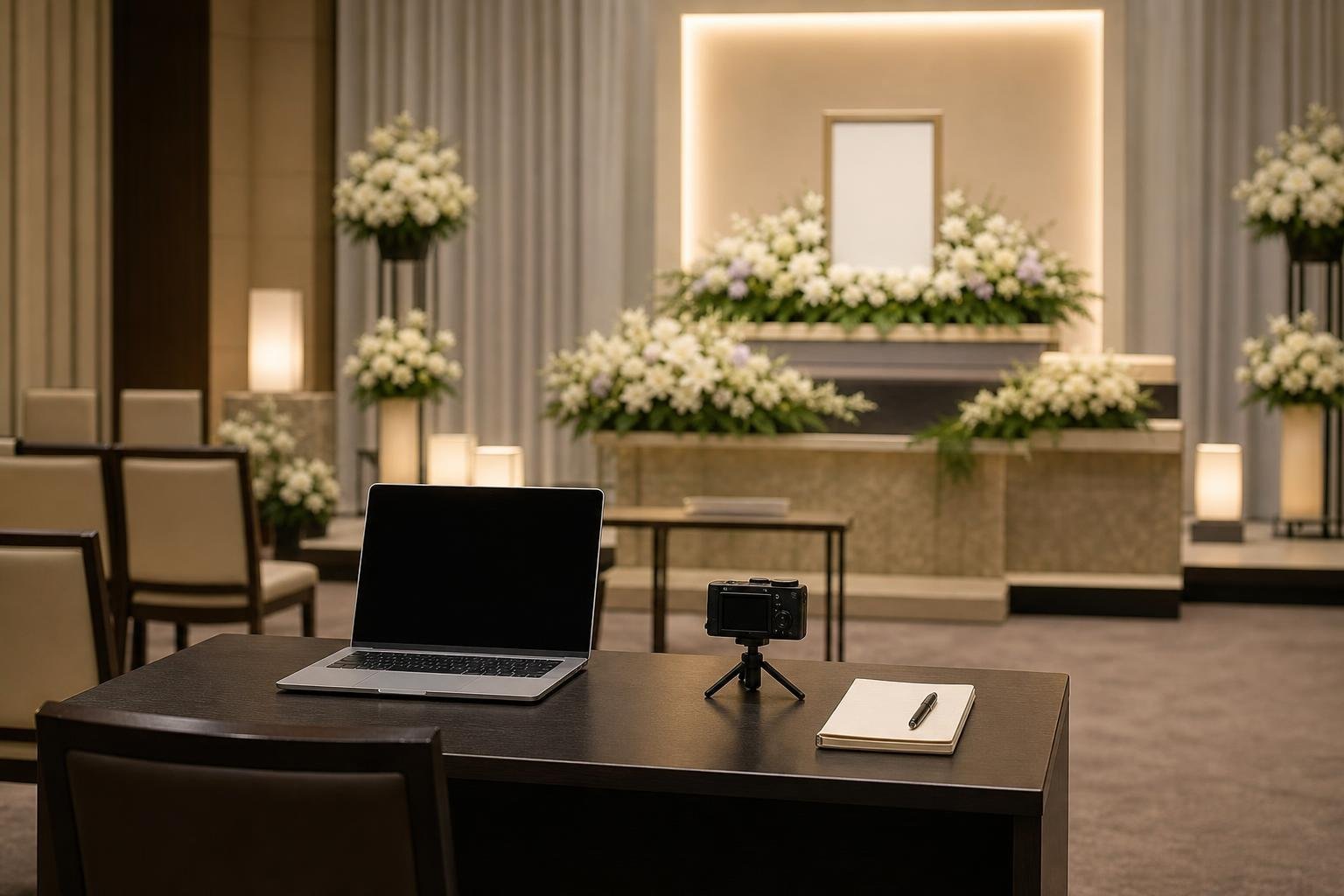
Whether or not you can film or stream at a funeral venue depends on the venue's rules and the venue's usage on the day. The placement of devices, the use of tripods, lighting, audio equipment, network connections, and whether staff can handle the operation cannot be determined uniformly. If you wish to stream, please communicate this specifically when booking the venue or discussing the funeral arrangements.
When confirming, it's helpful to explain your purpose, such as "We want to connect a portion of the ceremony online to overseas relatives by invitation only," and share the planned location and time for filming. Regarding filming the altar, coffin, those offering incense, religious figures, and attendees, it's essential to respect each person's wishes. Even if the venue allows it, not all attendees may want to be filmed.
While some venues, like Hikari Kaikan in Saitama City, are used as funeral facilities, cremation is handled at Urawa Crematorium or Omiya Seien. Since the venue for the ceremony and the crematorium have different roles, it is necessary to check separately when discussing live streaming. Please check with Hikari Kaikan regarding eligibility requirements, availability, and policies regarding filming and communication. When considering venues from Ageo City, Okegawa City, or Ina Town, it is best not to judge feasibility based solely on location, but to check with each potential facility to ensure peace of mind.
When considering the communication environment, we not only consider whether a connection will be established, but also what happens when the connection is interrupted.
For live streaming, the communication conditions within the venue will affect how easily the video and audio are received. The types of available connections, connection methods, areas with poor signal reception, and limitations on simultaneous connections will vary depending on the venue. If possible, it is a good idea to test the audio and video at the planned location in advance and have the overseas participants also check how well they can see and hear.
- Can I use the venue's network or wireless communication?
- Is it necessary to use our own communication methods?
- Where should the streaming devices be placed, and will they obstruct the movement of attendees?
- Is the microphone sound sufficient, or is there too much background noise?
- How to contact us and who to contact if your connection becomes unstable.
Since it can be difficult to perform detailed operations during the service, it's reassuring to designate someone in advance to handle the equipment. However, if that person is also a close family member, they may become preoccupied with the equipment and unable to focus on saying goodbye. Please consult with the funeral home about how much preparation is feasible, taking into account the burden on your family. If you wish to have the service streamed online, we will discuss the venue conditions and necessary preparations on a case-by-case basis.
I'll take the time difference into consideration and choose a way to participate that works for me.
Even if the date is set in Japan, it may fall late at night or early in the morning for family members overseas. In particular, the day's schedule, including the cremation, tends to be long, so it's more realistic to choose moments that are convenient for them to attend rather than aiming for them to see everything in real time.
- This document outlines the approximate start times, eulogies, and departure of the coffin, all based on Japan Standard Time.
- We will convert the time to the local time of the participating country/region and confirm it with the contact person.
- If the broadcast time is inconvenient for viewers, we will consider scheduling a short greeting at a different time.
- We will also inform you that the start time may change and consolidate all communication methods into one.
When sending invitations to relatives in different time zones, including both Japan Standard Time and their local time can help reduce misunderstandings. Since time differences can vary depending on the time of year in regions that observe daylight saving time, it's safest to double-check closer to the event date. For those unable to attend, you can consider ways to say goodbye that suit individual circumstances, such as creating an opportunity for family members to express their feelings later.
During the cremation process, we will discuss how to say goodbye to the deceased.
Filming and live streaming at a crematorium should not be treated the same way as filming at a funeral hall. Because procedures vary depending on the facility's rules, consideration for users, and the circumstances on the day, you should check with the facility in advance if you wish to film or live stream there. Avoid making plans to film or live stream before you have confirmed permission.
Even if you want to convey your feelings of farewell to family members overseas before the cremation, there are options other than video, such as a short video clip from the funeral hall before the coffin is taken out, or a representative giving a brief update later. Rather than focusing on what to show, prioritize the dignity of the deceased and how to respect the feelings of those present at the venue and those far away.
Privacy and contact agreements we want to share before the stream
We recommend sending invitations only to those who need them. It's also reassuring to gently inform attendees in advance not to forward viewing information to third parties, to let them know if they do not wish to record or save the screen, and that they may not be able to view the service due to poor communication. Some information, such as the deceased's photograph, the names of attendees, and religious practices, requires careful handling.
Live streaming is a way to bring family members who are far away closer to the ceremony. Don't just focus on the quality of the video and the perfect operation; prioritize how and by whom you can share your feelings.
When family members living overseas are involved in a funeral, there are often more things to confirm than usual, such as language, time differences, and venue rules. Making a list of your wishes will make it easier to communicate priorities during the meeting. We offer multilingual consultations via email. For individual interpretation, live streaming at the venue, feasibility of mortuary arrangements and religious ceremonies, and necessary costs, please consult with us in advance, depending on your situation.
 Consult by Email
 Consultation /
  A Gentle Farewell