
 Japanese
 English
 Chinese
 Vietnamese
How to bring cremated remains from Urawa to another country after a funeral | Things to check with airlines and destination countries
Some families who have held a funeral or private memorial service in Urawa wish to take the cremated remains back to a place overseas that was significant to the deceased. In such cases, it is important to carefully check not only the procedures after cremation, but also the transportation conditions of the airline and the acceptance conditions of the destination country or region.
There are several things to confirm before your departure date when traveling abroad. You may feel anxious about unfamiliar languages and paperwork. Don't rush into decisions; instead, consult with the airline, the embassy or consulate of your destination country, relevant organizations, and, if necessary, the funeral home, and keep a record of everything you confirm as you proceed.
First, let's consider "bringing it yourself" and "sending it separately" separately.
There are two ways to transfer cremated remains overseas: the family can bring them by air, or they can send them through a transportation company. The requirements, procedures, and timelines are not the same for each method. First, your family should decide which method they prefer.
Even if you bring the urn yourself, whether it can be carried on board or checked as baggage may vary depending on the airline. You should also check the material and size of the urn, the condition of the container, and how it will be handled at security screening before booking or departing. It is best not to rely solely on the booking counter, but to ask the international baggage and security department for specific details.
When choosing to ship separately, the process may not be the same as regular parcel shipping. Before making a request, be sure to check the service provider, required documents, customs clearance, and on-site pickup procedures. Since the process may take time, it is important to plan well in advance if you have travel dates or burial dates in mind.
Things to tell the airline and confirm
When contacting the airline, clearly state your purpose: "I would like to take cremated remains overseas." Providing information such as the route of travel, whether there are any layovers, the planned travel date, and the approximate size and material of the container, to the best of your knowledge, will help them process your request more efficiently.
- Can I bring the cremated remains into the cabin, or do they need to be handled as checked baggage?
- Material, dimensions, and packaging requirements for urns and boxes.
- Please specify the name of the document you are requesting to verify, and whether the original, a copy, or a translation is required.
- Are additional checks or declarations required at the transit airport?
- Expected procedures during security checks and the necessity of prior declaration
- Information to receive from the airline after booking, and the location for check-in on the day of departure.
Information may vary depending on the route, departure point, transit points, and airline regulations. Even with the same flight number, the actual operating airline may differ, so be sure to check with all airlines you will be using, not just the airline you booked with. If you receive information by phone, make a note of the contact person, the date of confirmation, and the main points of the answer, as this will be helpful when you receive explanations on the day of your flight.
Check the acceptance requirements of your destination and transit points.
Even if an airline allows you to carry it on board, this does not guarantee that you will be allowed to bring it into your destination country or region. Entry declarations, documentation proving cremation, death-related documents, and the handling of their translation and authentication vary depending on the regulations of your destination country. For itineraries involving immigration checks or baggage re-checking at transit points, you may need to check the regulations for those transit points as well.
Potential sources of information include the embassy or consulate of your destination country, customs, and other relevant authorities. However, since each office has different responsibilities, be sure to clarify which stage of the process—bringing in the deceased, customs clearance, or burial or interment—the information pertains to. If you plan to inter the remains at a religious facility or cemetery in your destination country, it's best to inquire about the necessary documents and whether reservations are required as early as possible to ensure a smooth and stress-free preparation process.
I will carefully keep the documents I receive after cremation in Japan.
Regardless of whether the cremation took place in Urawa Ward, Saitama City, when preparing to take cremated remains abroad, checking the documents received in Japan is fundamental. You will need to follow the instructions of your destination country and airline to find out which documents are required, but be sure to keep documents such as cremation certificates safe so you don't lose them.
You may be asked to provide a translation. In that case, you should first confirm with the recipient which languages the translation needs to be into, whether only the translation is required, or whether the original or a copy should be attached. Even if the names of documents are similar, their purposes may differ, so it is important not to prepare them based on your own judgment, but to record the name and format of the document you are asked to provide.
The order in which to calmly check documents during preparation.
- I will check with the airline regarding the loading procedures and required documents.
- Check with the relevant authorities at your destination and transit points to confirm the documents required for bringing in and declaring items.
- Check to make sure you have all the documents you were instructed to submit, and if anything is missing, consult with the issuing authority or the relevant department.
- If translation or certification is required, please check the format required by the recipient before preparing.
- Organize the original and copies and store them separately in places where you can easily present them during your trip.
Containers and packaging are designed with both respect and safety in mind.
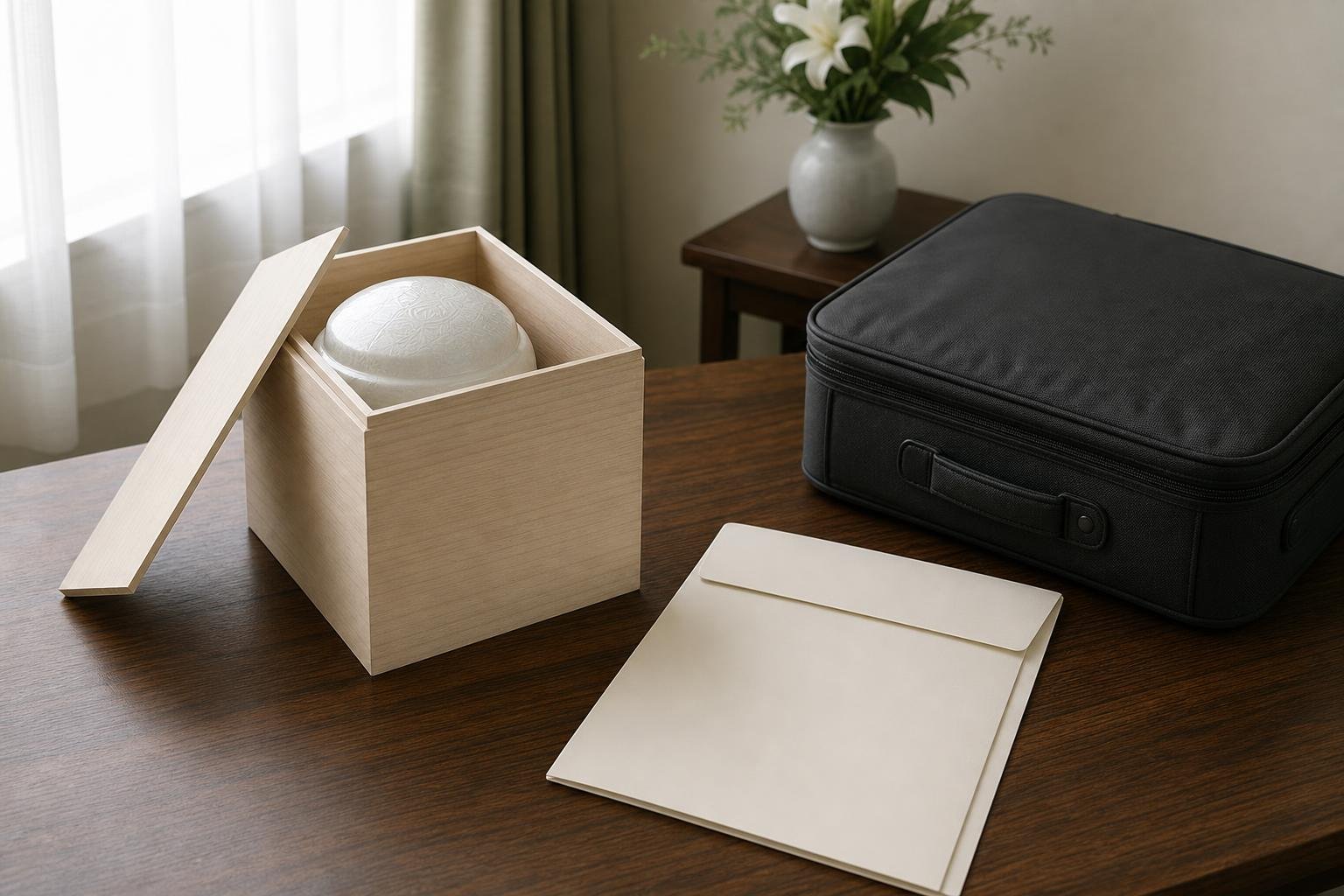
An urn holds precious cremated remains. When transporting it, check that it is not made of a fragile material, that the lid is secure, and that it is protected by an outer box or cushioning material. However, do not make your own judgments regarding sealing or packaging methods; always prioritize the instructions given by the airline if they specify them.
Since security checks cannot visually inspect the inside of containers, additional checks may be required. It is a good idea to have relevant documents readily accessible in case you need to explain the situation to security personnel. You do not need to explain the situation in detail to those around you, but it is recommended that you share the necessary information with your companions so that you can calmly provide the required explanation.
To families who have held funerals in the Urawa area
Urawa is an area where it is easy to find a place to consult, mainly in Urawa Ward of Saitama City, but also in Minami Ward and Midori Ward of Saitama City. There may be cases where people wish to have a family funeral with only close relatives in attendance, and then inter the remains overseas. Preparing for a funeral and arranging overseas travel simultaneously can be a great burden for the family.
At Seikatsu Funeral Service Center, we offer consultations regarding transportation, storage, and considerations for religion and culture. When bringing a body back overseas, it is essential to check the conditions set by the airline and destination. Instead of trying to solve all your questions at once, first organize the information in the following order: documents received after cremation, the airline you will use, and your destination and transit points.
Immediately after saying goodbye to a loved one, even just reading the paperwork can be emotionally draining.Summarize the answers from each source in a memo and share it with your family.However, this will help reduce misunderstandings. If you still have concerns about your preparations, we recommend checking with the relevant offices as early as possible, rather than waiting until just before departure.
 Consult by Email
 Consultation /
  A Gentle Farewell